.

Monday, 5 December 2011

Putting the male parent first

   My father, in common with many working men in the England of my youth, kept birds as a hobby. Next to our garden shed, which would come to serve as a hide, he erected an aviary for a trio of fantail doves he had bought in a local pet shop. He built the structure of the 'flight', as we called it, with scrap wood he carried home from the factory. My father would later move from doves to canaries and other finches, a shift marked by his gift to me, for my seventh birthday, of a pair of Greenfinches (Carduelis chloris). Money was tight and it would be easy to see my dad as having used my birthday as an excuse to buy the birds for himself, but I clearly remember my febrile anticipation of their arrival. It is irrelevant that my reaction was the result of conditioning; what my father really gave me was enthusiasm.  


   Cousins of mine took an interest in this pastime, young men without academic qualifications who would go on to have aviaries of their own. They gradually accrued a deep understanding of genetics as a knowledge of bloodlines is essential in developing (as they did) healthy colour variants from limited gene pools. It's clear that these acolytes were heavily influenced by the calm of our little wooden haven and the knowledgeable, taciturn man who oversaw it. All problems of work and family were forgotten as they sat in quiet contemplation listening to the soft chirrupings that surrounded them - the only distraction the rustles emanating from the corner where a boy sat on a tea chest poring over his precious copy of “Cage and Aviary Birds”.


   Occasionally we created hybrids. A pair of finches of different species could be induced to breed if they were kept in isolation. Some of these hybrids were mules, a 'mule' being a cross between a canary and another species of finch. Birds bred this way were not only sterile but also at a social disadvantage; I remember a Goldfinch mule whose ethereal song enchanted human ears, but whose mongrel melodies bewildered the hens for whom he sang. My favourite was a Siskin-Greenfinch cross whose plumage was so harmonious it made the bird appear to be a genuine species, unlike the Goldfinch-Bullfinch that, to me, looked strangely cobbled together. An aviculturist such as my father would have noted that I wrote 'Goldfinch-bullfinch' and not 'Bullfinch-goldfinch' as male Bullfinches cannot be induced to mate with any other species and when describing a hybrid it is traditional to put the male parent first.


Friday, 18 November 2011

Coots on Gunnera


Gallinules preening on immense peltate leaves lend Kew Gardens an Amazonian air.


Monday, 14 November 2011

Show's over

   Yesterday a headline in the French news read, “Berlusconi – une sortie en catimini”. I couldn't recall seeing the word catimini before and so looked it up.
   It sounded a little as if his exit from political office was chaotic or calamitous, but it turned out leaving en catimini means “sneaking out” or even “sneaking out under shameful circumstances”. Some say that the shameful aspect can be explained by the association of the word catimini with menstruation, “catamenia” being a medical word for menstrual fluid (in the 16th and 17th centuries the phrase avoir ses catimini meant “to have one's period”). However, others think this etymology fanciful and suspect that catimini has more to do with the skulking habits of felines and has its origins in the Picard language of northern France; cate (cat) + mini from min also designating “cat” and the root of minou, minette (kitty, pussy). Minette and “pussy” both refer to a cat and both are slang terms for the female genitalia – a linguistic analogy demonstrated by French and English sub-editors who translated Berlusconi's crass exhortation, Forza Gnocca! (an intended parody of his party's slogan, Forza Italia!) as Allez Minette! and “Go Pussy!”.


Well, whatever the language, he's gone. Probably.


Saturday, 12 November 2011

Living sculpture

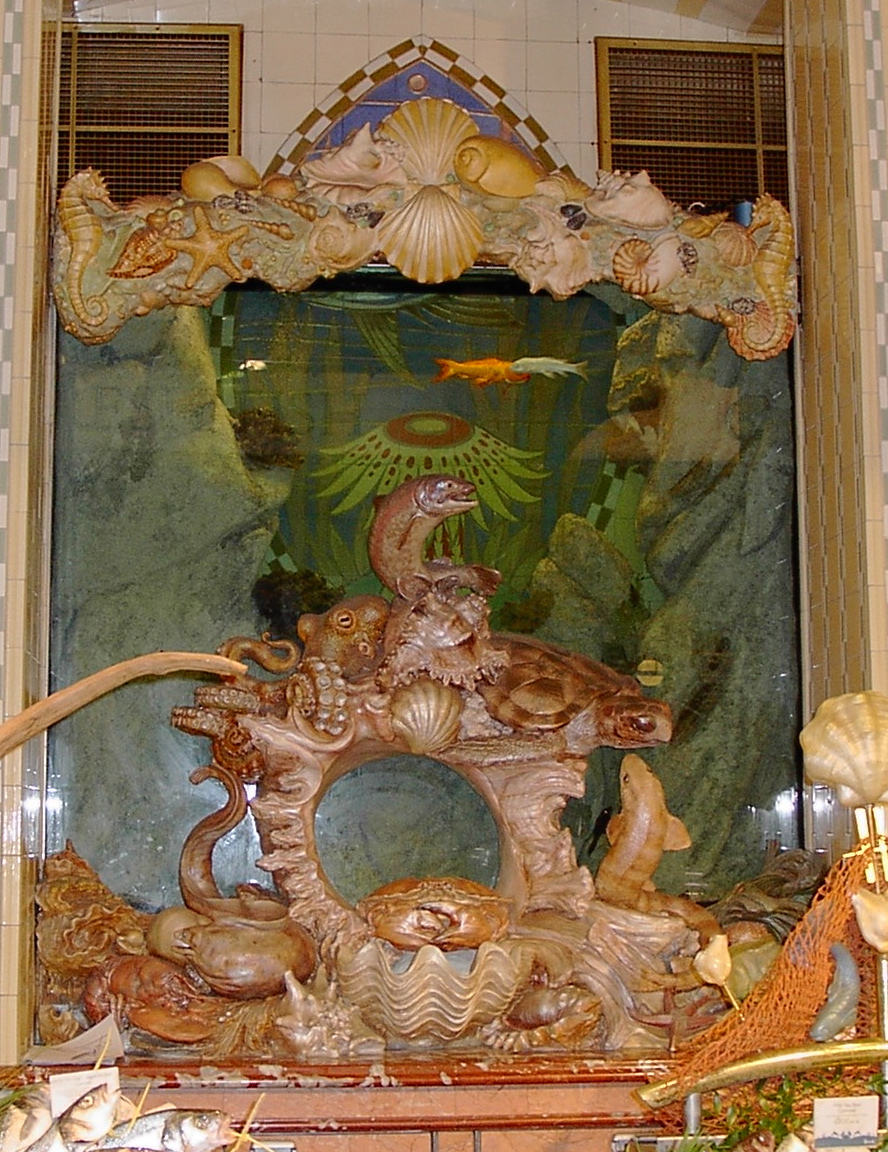
   This summer I nipped into Harrods, a department store in in the West End of London. It sells nothing of interest, but is well worth a visit, or more accurately, the food hall is worth a visit. Get there at ten in the morning when it's opening and one can examine the decorative sculptures before the place fills up. It's a good time to take photographs and generally get in the way of the employees trying to set up the stands.


   Mermaids clinging each to each. I like the way their caudal fins are gathered in wet, lazy folds, a much more sensual arrangement than the way their tails are traditionally represented.

   It seems these pieces were created at the London workshops of "U.K. Sculptors".

   The wall tiles were designed by W J Neatby (1860-1910).


   They're real fish swimming around behind the leaping sea trout. I wonder who feeds them, the fishmongers or the maintenance people? I would be nice to think it's some impossible-to-fire old retainer whose sole responsibility it is and who is a vestige of the old days when Harrods boasted that it sold everything from a pin to an elephant. I remember as a boy taking the famous puff seriously and being disappointed at the pet section's paucity of p-p-pachyderms. There were monkeys in cages, and even galagos - nothing there now of course, except acres of g-plan sofas.


Assorted game ignored by an urban fox who's stealing away to raid a few dustbins.


            More splendid Neatby ceramics. These tiles and peafowl weren't in the food hall, they were in the bauble and wig department.

PS Don't race round to see these creations just yet – today I read that Harrods has been sold and is closed for two years for refurbishment.

   And the fish, who will feed the fish?  


Wednesday, 9 November 2011

Confession of a nympholept


 Illustration of a European Robin by Paul Barruel (1901-1982)


   I picked up a Robin (Erithacus rubecula) yesterday. It had stunned itself on a window pane. I took it into the garden, held out my open hand and waited for it to revive and take off. It revived, but before flitting away decided to linger for some long intimate minutes. It started to preen, conscientiously running each primary feather through its mandibles, apparently happy to be sitting on the palmate branch of an enthralled tree. The bird was so ineffably beautiful I didn't want to blink in case it disappeared, and so light that if I wasn't looking at my hand I wouldn't have known there was anything there.


Friday, 4 November 2011

When Methodists dream


Wedged between the tumescent guru being bearded by a prude
And the spluttering priest being suckled by a nihilistic nude,
I wonder if I was right to have killed that man I found so rude
And who hastens toward me.


SRP


Friday, 28 October 2011

Haydn to Nothin'

   The only fiction I seem ever to read is “The Journal of Edwin Carp”, to the extent that I've almost memorised it. However, I've recently discovered a way of expanding my reading without straying from my obsession; I came across a copy of Richard Haydn's masterpiece that was translated into French by Henry Muller.


I intend to search the Internets for versions in other languages; surely others have translated this important work?

Whether other versions are any good is another matter. Literary translations can never be exact, they can only detract from or improve on the original, and given that I think “The Journal of Edwin Carp” is perfect I suppose I am doomed to disappointment. Here is an extract, it describes a scene where Maude, Carp's fiancée of eleven years, helps out in Carp's boarding house;

“The happy willingness with which she performs her self-imposed duties is a joy to behold. Indeed, yesterday, when I entered the kitchen and discovered her ironing our paying guests' personal laundry, I was so affected by her flushed, smiling face that I could not refrain from taking her in my arms and kissing her. My impulsiveness caused her to scorch Mr. Murke's dickey. Fortunately it is reversible.

This is rendered by Henry Muller as;

“La bonne volonté avec laquelle elle s'adonne à ces travaux fait mon bonheur. Et, pas plus tard qu'hier, en entrant à la cuisine et en la voyant repasser le linge personnel des hôtes, je fus si touché par son souriant visage que je ne pus empêcher de la prendre dans mes bras et de l'embrasse. Ce geste impulsif provoqua une brûlure sur le caleçon de M. Murke; il est fort heureusement réparable.”

Muller obviously felt that plastron (in this case “replaceable shirt-front”) lacked the comic potential of “dickey” and so replaced it with caleçon (under-shorts) incurring in doing so the inevitable and detrimental loss of “reversible/réversible”. A valiant effort, but the result could never be as good as the original whose comic brilliance, intensifying as it does in the last sentence - down to the very last word - is inimitable.