.

Thursday, 27 October 2011

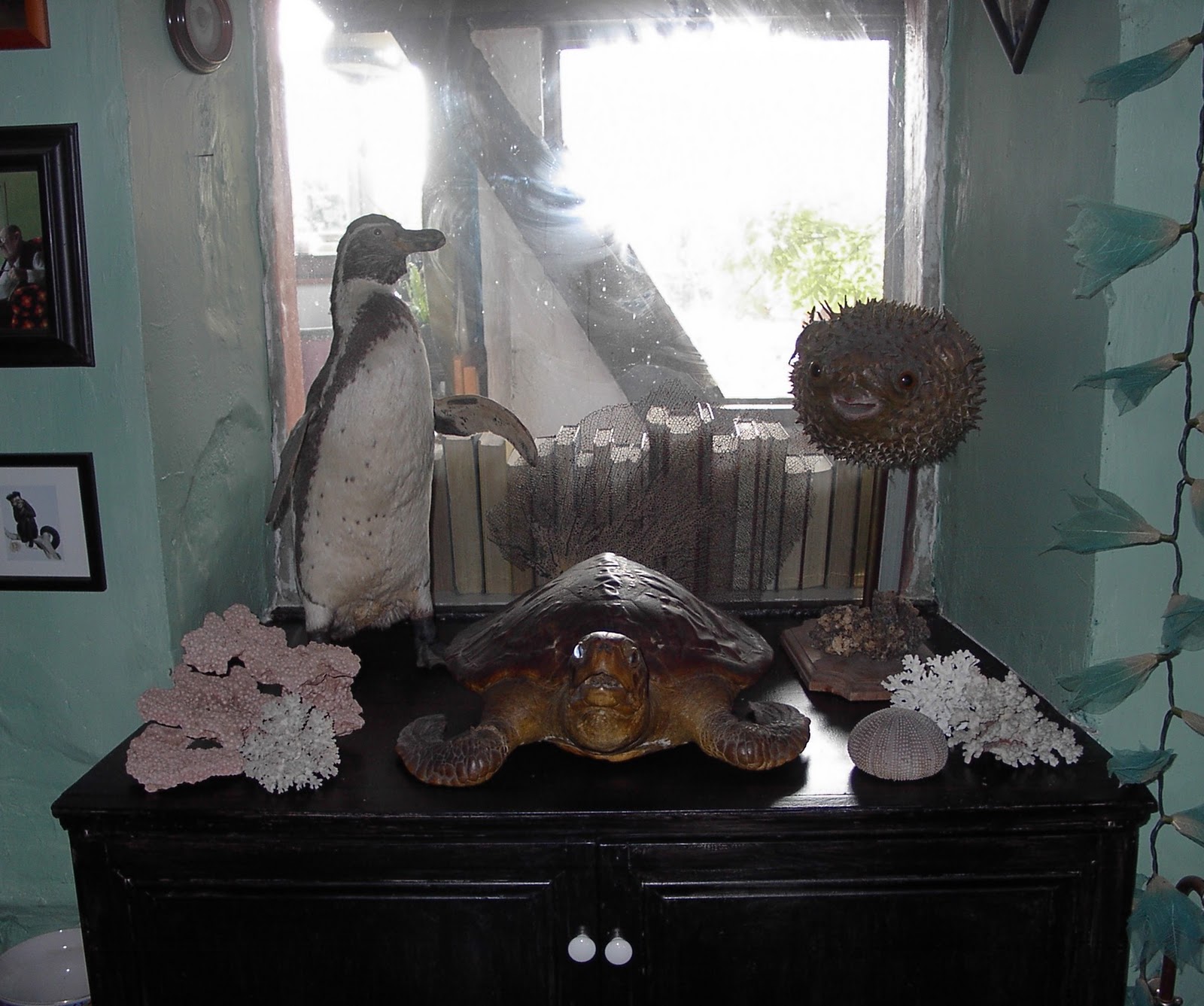
On nature's shelf

Decades ago I would gaze in wonder at my classroom's nature shelf.


 Since then institutions seem to have given up on me (hopefully for good, though we know that the first involuntary dribble and relatives you've never heard of do what's best for you), but I still stare at nature shelves, especially my own,


and their occupants, careful not to over-salivate, stare back at me.


Thursday, 20 October 2011

Points of View


 Inspired artwork by Jacque-Louis David, Paul-Jacques-Aimé Baudry and Frank Cotham.


Tuesday, 18 October 2011

Terra cognita


May you be big as three hills,
Too big for the crows to see.

Children will climb your slopes,
Tumble down your flanks.
Exhausted, they will sleep on you,
Your pulse their pulse.


SRP


Thursday, 13 October 2011

Art Life Death


“The Alchemist” by William Fettes-Douglas (1822-1891)


 “The Naturalist” by Carl Spitzweg (1808-1885)

   I find these two paintings very reassuring, I suppose they're meant to reassure, portraying, as they do, stereotypes. I like the apparent disorder found in both the scholars' rooms, it's somehow easy on the eye, or at least it is on my eye – especially the lower one, I think the setting is superb.

   Spitzweg was immensely popular in Germany and, despite his sympathetic portrayals of Jewish subjects, he was a favourite of Adolph Hitler who collected his work.


   Above is a self-portrait by William Fettes-Douglas (c 1845). The long nose and incipient sneer look to me as if they belong to a younger version of the languorous fellow pictured below.


   In fact this brilliant portrait, “The Yellow Scale” by František Kupka (1871-1957), was painted in 1907, 16 years after Fettes-Douglas's death. It's most likely inspired by images of Baudelaire merged with aspects of Kupka's own physiognomy.

   František Kupka could not have survived as an artist without the art-collector and industrialist Jindřich Waldes, a friend who supported him for twenty years until, in 1938, the Hitlerian regime sent the Jewish Waldes to Dachau concentration camp. 


Thursday, 6 October 2011

Malplaquet House

   Malplaquet House is in London's East End. It was named after the eponymous battle fought in 1709 that resulted in a Pyrrhic victory for the Duke of Marlborough and his gang against the French and their gang (the 'victors' lost over 21,000 men, twice that of those who retreated to fight another day).

   The house has had a chequered history but is now owned by Tim Knox and Todd Longstaffe-Gowan who have decorated it almost perfectly. I say 'almost' because a discerning eye would appreciate that it needs more old taxidermy.

Photo; Barry Lewis

Look at that; a nice Cape buffalo with turtle skull and assorted whale vertebrae.  


Fine Warthog skull on the extreme right, I think that's a Zebu top left.


An impressive pair of Gannets, and an interesting gallinule next to the egret.


A successful landing


An excellent Himalayan Tahr


Behind the Ostrich skeleton is the Zebu head again and under that a Razorbill, and under that a Golden pheasant, and under that- it's difficult to make it out even with my magnifying glass -  


- ah, now I see, fascinating...


Thursday, 29 September 2011

Pink palindromes


   I wish I knew who took this stunning photograph (I presume it's a photograph), it's of Roseate spoonbills (Platalea ajaja - Ajaja is a South American native name for the bird).


   As with pink flamingos their roseate pigmentation is due to the canthaxathin in the crustaceans they eat. The ethereal beauty of their plumage is a challenge for any artist to capture, this painting is by Krysti Melaine;


   “A bowl of spoonbills” isn't a main course in a Dadaist restaurant; it seems a “bowl” is the collective noun pedants apply to spoonbills. I imagine it's because the drinking bowl is synonymous with conviviality and that these birds, when sifting through the mud of shallow waters with their spatulate bills, often mix with other large wading birds. As a possible result of their gregariousness Roseate spoonbills are serially monogamous (Parallels can be found in nature for any form of aberrant behaviour – including one's own).


Tuesday, 27 September 2011

Of a different stripe


   As there are only a couple of thousand tigers left in the wild tiger skin rugs often elicit revulsion, but this is a recent phenomenon, previous reactions were often more carnal as can be seen in this detail from Stanley Spencer's 1940 self-portrait with the redoubtable Daphne Charlton,“On the tiger skin rug” -


    - though there were others less comfortable with tigers who'd had their ribs ablated;

                                                                                                                C E Jensen 1892